How to Build a Minimum-Stay Strategy Without Guessing
How to Build a Minimum-Stay Strategy Without Guessing
Should your summer calendar require five nights?
Four?
Three?
There is no universal answer.
Minimum-stay strategy depends on the property, season, booking window, demand conditions, calendar shape, and business objective.
That means the better question is not:
"What is the perfect minimum stay?"
It is:
"What is current booking behavior telling us?"
Minimum Stays Are Revenue Levers
A minimum stay changes who is eligible to book the property.
A five-night requirement may protect valuable inventory during strong demand.
But if the remaining guests are searching for four-night stays, that same rule can reduce the property's exposure to bookable demand.
The restriction therefore needs to evolve with the opportunity.
Test Instead of Guessing
Revenue Academy provides a simple way to think about uncertain minimum-stay decisions.
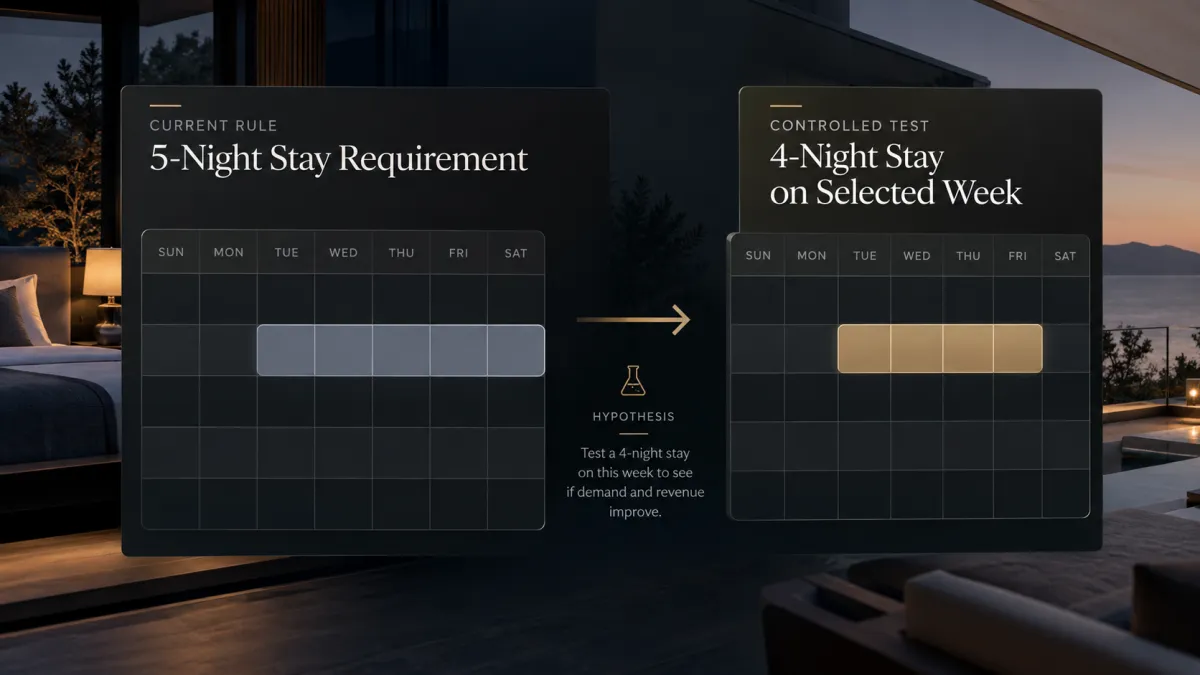
Suppose you are unsure whether summer demand will support a five-night minimum.
You do not necessarily need to change the entire season.
Instead, test a smaller part of the calendar.
For example, adjust one week from a five-night minimum to four nights.
Then observe the response.
What Does the Response Tell You?
If the dates book quickly after the change, that provides evidence that four-night demand exists at the current positioning.
You could then form another hypothesis.
Perhaps you retain the four-night pattern but test a stronger rate.
If nothing happens, that is information too.
The purpose of the test is not to prove that four nights is universally better than five.
It is to learn how demand responds to the restriction.
Change One Thing When Possible
When you change several settings simultaneously, learning becomes more difficult.
Was it the price?
The minimum stay?
A discount?
A different premium?
The clearer the test, the more useful the response becomes.
Think in terms of:
Hypothesis → One Change → Response → Next Decision
Don't Turn One Result Into a Permanent Rule
A successful four-night booking does not mean the property should use four-night minimums forever.
Demand changes.
Seasons change.
Booking windows change.
Calendar conditions change.
The result is evidence for the next decision, not a permanent commandment.
That is the larger revenue-management lesson.
Rules should serve the strategy.
The strategy should not become trapped by the rules.


