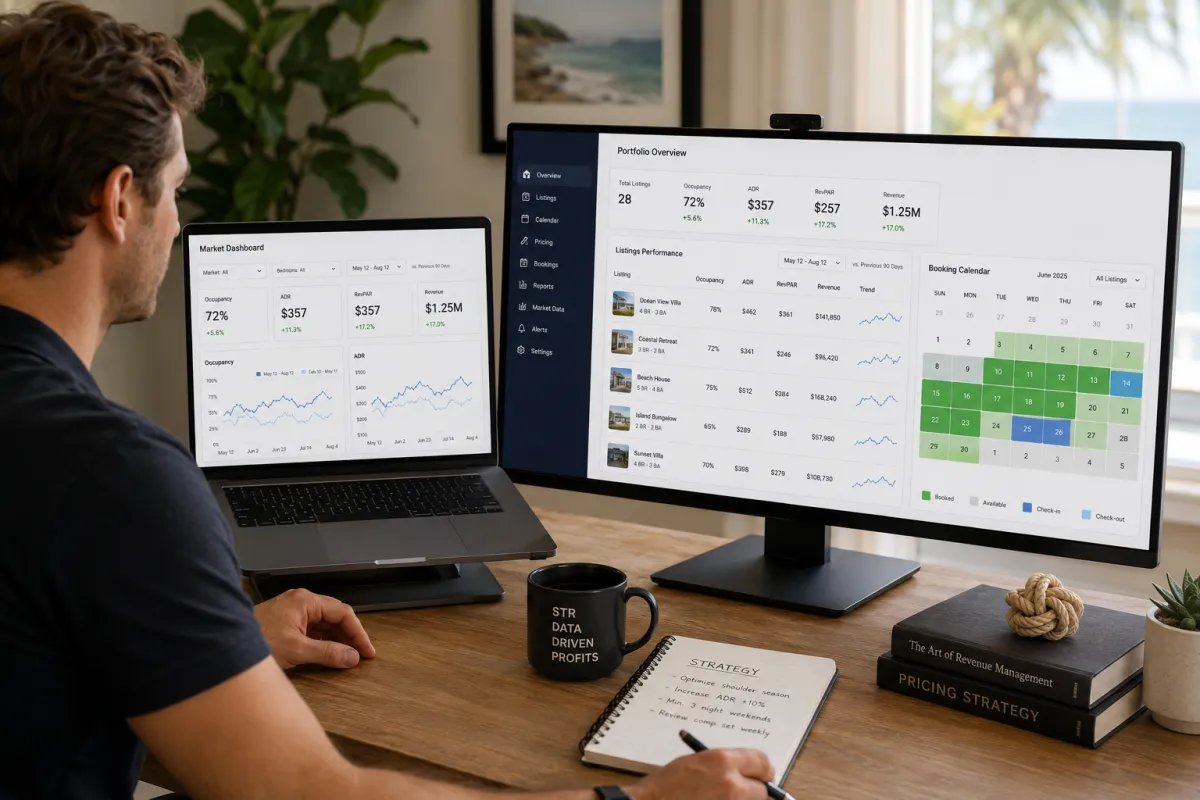
The Most Important PriceLabs KPIs for Short-Term Rental Revenue Management
The Most Important PriceLabs KPIs for Short-Term Rental Revenue Management
One of the biggest differences between casual hosting and professional revenue management is measurement.
Most operators check bookings.
Revenue managers track performance indicators.
These metrics help operators move beyond guesswork and start understanding:
how their listing is pacing
where demand is strengthening
whether pricing is too aggressive
whether occupancy targets are realistic
how their property compares to the market

What Is a KPI in Revenue Management?
KPI stands for Key Performance Indicator.
These are measurable metrics used to evaluate how a property is performing financially and operationally.
According to the session, operators should become comfortable tracking KPIs because they help answer questions like:
Is my pricing strategy working?
Is demand increasing or slowing?
Am I outperforming the market?
Are my rates too high or too low?
How efficiently am I converting demand into revenue?
Revenue management becomes much more strategic once operators learn how these metrics work together.
Occupancy: The Foundation of STR Performance
One of the first KPIs discussed in the session was occupancy.
Occupancy measures the percentage of available nights that are booked over a given period.
For example:
If a listing books 21 nights out of 30 available nights, occupancy is 70%.
Occupancy helps operators understand:
booking health
demand consistency
pacing trends
seasonal performance
Inside PriceLabs, occupancy can be viewed across multiple windows:
next 10 days
next 30 days
next 60 days
next 90 days
This allows operators to quickly identify where booking gaps exist.
As Emile explained, shorter windows like 10-day occupancy are especially useful in markets with strong last-minute booking behavior.
ADR: Average Daily Rate
ADR stands for Average Daily Rate.
This measures the average nightly rate booked over a period of time.
ADR helps operators evaluate:
pricing strength
rate positioning
revenue efficiency
A property with high occupancy but very low ADR may still be underperforming financially.
On the other hand, extremely high ADR with weak occupancy can also signal pricing problems.
Revenue management is ultimately about balancing both occupancy and ADR effectively.
Market Occupancy and Pacing
The session also emphasized the importance of understanding market occupancy.
Market occupancy tracks how booked nearby comparable listings are within the local market.
This provides important context because your property does not operate independently.
If nearby competitors are filling quickly:
demand may be increasing
pricing power may strengthen
occupancy pressure may decrease
If the market is pacing behind previous years:
pricing sensitivity may increase
operators may need to become more competitive
booking windows may shorten
Understanding market pacing allows operators to react earlier instead of waiting until booking gaps become severe.
Minimum Price and Minimum Price Hits
One of the more advanced concepts introduced during the session was minimum price hits.
Inside PriceLabs, operators can establish a minimum nightly rate floor.
The pricing algorithm will not drop below this number.
The problem is that many operators set unrealistic minimums based on emotion rather than market behavior.
That is where minimum price hits become useful.
This metric measures how often your pricing algorithm is reaching the minimum allowed rate.
For example:
If your listing hits the minimum price on 80% of upcoming dates, your minimum may be too high relative to demand.
If you never hit your minimum price, your pricing floor may not be affecting strategy at all.
According to the session, this metric becomes especially useful during slower seasons and last-minute booking windows.
It helps operators understand whether pricing restrictions are limiting booking opportunities.
MPI: Market Penetration Index
The session also briefly introduced MPI, or Market Penetration Index.
MPI compares your occupancy performance against the broader market.
In simple terms:
an MPI above 100 suggests your property is outperforming the market
an MPI below 100 may indicate underperformance relative to competitors
This metric is valuable because it removes some of the emotion from performance evaluation.
Instead of asking:
“Do I feel busy?”
operators can ask:
“Am I capturing more demand than my market competitors?”
That creates much clearer decision-making.
Why Dashboard Customization Matters
One practical takeaway from the session was the importance of customizing your PriceLabs dashboard.
Many operators only view the default metrics.
But revenue managers often configure dashboards to monitor:
occupancy windows
minimum price hits
last booked date
pacing
revenue projections
MPI trends
The goal is to create a quick operational snapshot that reveals:
which properties need attention
where pricing pressure exists
which listings are underperforming
where demand opportunities may exist
As Adam explained, experienced operators often rely heavily on visual dashboards to identify problems quickly.
Revenue Management Is About Context
One of the strongest themes throughout the Revenue Academy session was that no KPI should be viewed in isolation.
High occupancy alone does not guarantee success.
High ADR alone does not guarantee success.
Strong revenue in one month may still underperform relative to market conditions.
Revenue management requires context.
Operators need to understand:
market conditions
seasonality
competitor pacing
booking windows
property positioning
demand strength
KPIs help organize those signals into measurable insights.
Better Metrics Lead to Better Decisions
The purpose of tracking KPIs is not simply collecting data.
The purpose is making better decisions.
The most effective operators use metrics to:
identify opportunities earlier
adjust pricing strategically
monitor booking health
understand market behavior
improve long-term revenue performance
Dynamic pricing software becomes significantly more powerful once operators understand the data behind the automation.
That is when pricing strategy becomes intentional instead of reactive.
Key Takeaways
KPIs help operators measure booking and pricing performance objectively.
Occupancy and ADR are foundational STR revenue metrics.
Market occupancy and pacing reveal broader demand conditions.
Minimum price hits help identify restrictive pricing floors.
MPI compares your performance against market competitors.
Dashboard customization improves visibility and decision-making.
Revenue management requires interpreting multiple KPIs together.


