Occupancy vs. ADR vs. RevPAR: What Should STR Operators Optimize?
Occupancy vs. ADR vs. RevPAR: What Should STR Operators Optimize?
A full booking calendar feels good.
But occupancy alone does not tell you whether your revenue strategy is working.
Short-term rental operators need to consider three connected measurements: ADR, occupancy, and RevPAR.
ADR: What Did Your Sold Nights Earn?
Average Daily Rate, or ADR, represents the average rate earned across occupied nights.
ADR helps you understand rate performance.
But ADR alone is incomplete.
A very high average rate is not particularly useful if too many available nights remain unsold.
Occupancy: How Much Inventory Did You Sell?
Occupancy measures the share of available nights that were booked.
This provides another important part of the picture.
But optimizing occupancy without considering rate creates its own problem.
Lowering prices can help fill more nights while producing a weaker overall revenue result.
RevPAR Connects the Two
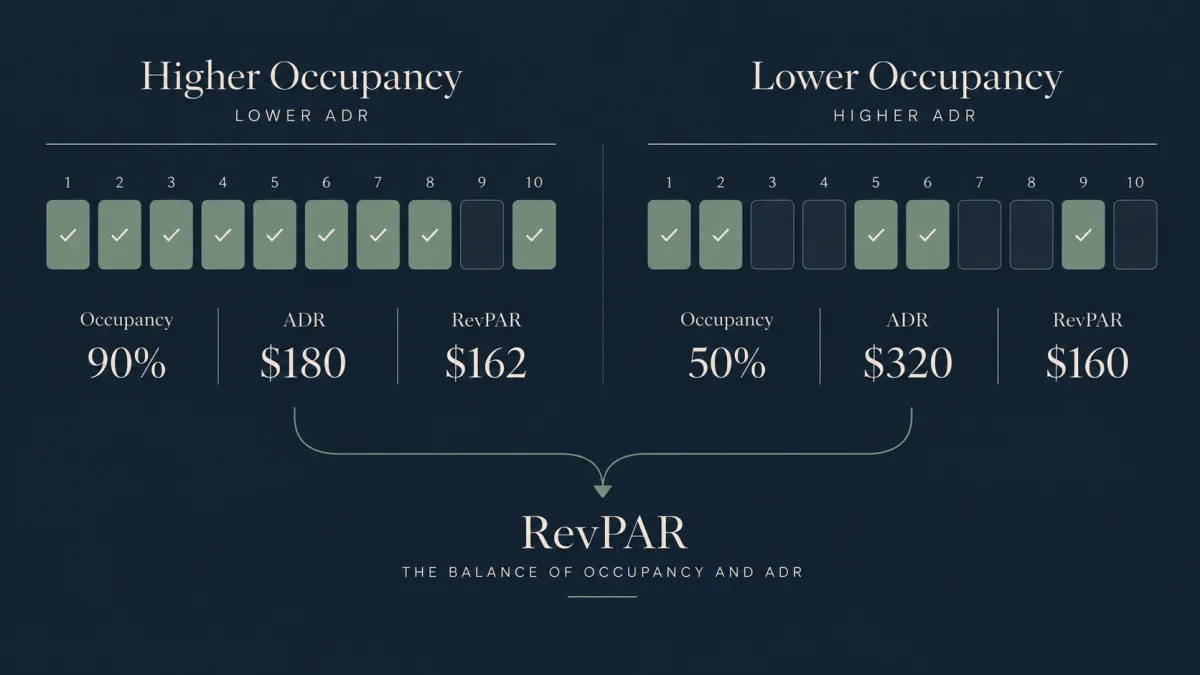
RevPAR, or revenue per available rental night, helps evaluate rate and occupancy together.
Consider a simple hypothetical involving ten available nights.
Property A sells eight nights at an average of $300.
Revenue: $2,400
RevPAR: $240
Property B sells all ten nights at an average of $220.
Revenue: $2,200
RevPAR: $220
Property B has higher occupancy.
Property A generated more revenue across the same available inventory.
The lesson is not that operators should always prioritize rate over occupancy.
The lesson is that occupancy alone cannot tell you whether the strategy worked.
Calendar Shape Matters Too
Even RevPAR should be interpreted in context.
Two booking patterns could produce similar occupied-night totals while leaving behind very different opportunities.
One reservation might fit neatly between existing bookings.
Another might create an awkward one-night gap that becomes difficult to sell.
A longer stay might be particularly valuable in a soft season.
During strong demand, the same stay pattern might unnecessarily restrict the calendar.
Revenue management therefore requires more than maximizing one KPI.
The Right Trade-Off Changes
There is no single correct balance between ADR and occupancy for every property and every period.
During high demand, protecting rate and stay patterns may make sense.
During a softer period with a short remaining booking window, increasing occupancy or attracting longer stays may become more important.
Your position against the revenue goal also matters.
The objective is to choose the trade-off intentionally rather than allowing one metric to become the entire strategy.
A full calendar can be a strong result.
So can a calendar with slightly lower occupancy and stronger rate performance.
The numbers only become meaningful when you evaluate them together and in context.


