How to Use Shock Pricing Without Destroying Your Revenue Strategy
Revenue Management Doesn’t Start With Pricing
How to Use Shock Pricing Without Destroying Your Revenue Strategy
Few topics in revenue management generate more debate than discounting.
Many operators fear lowering prices because they believe it weakens perceived value.
Others discount too aggressively and end up damaging profitability.
The reality lies somewhere in between.
There are situations where maintaining a high rate is the right decision.
There are also situations where holding firm becomes far more expensive than adjusting pricing.
This is where shock pricing enters the conversation.
During Revenue Academy Week 5B, Emile and Adam Blott explored how experienced revenue managers sometimes use aggressive short-term pricing adjustments to recover occupancy and create booking momentum.
The key is understanding when it makes sense and when it doesn't.

What Is Shock Pricing?
Shock pricing refers to a deliberate, temporary reduction in price designed to stimulate bookings when demand is not materializing as expected.
Unlike standard dynamic pricing adjustments, shock pricing is more aggressive.
The goal is not incremental improvement.
The goal is generating immediate market response.
Revenue managers may use shock pricing when:
Occupancy is significantly behind target
Booking windows are closing
Market demand is weak
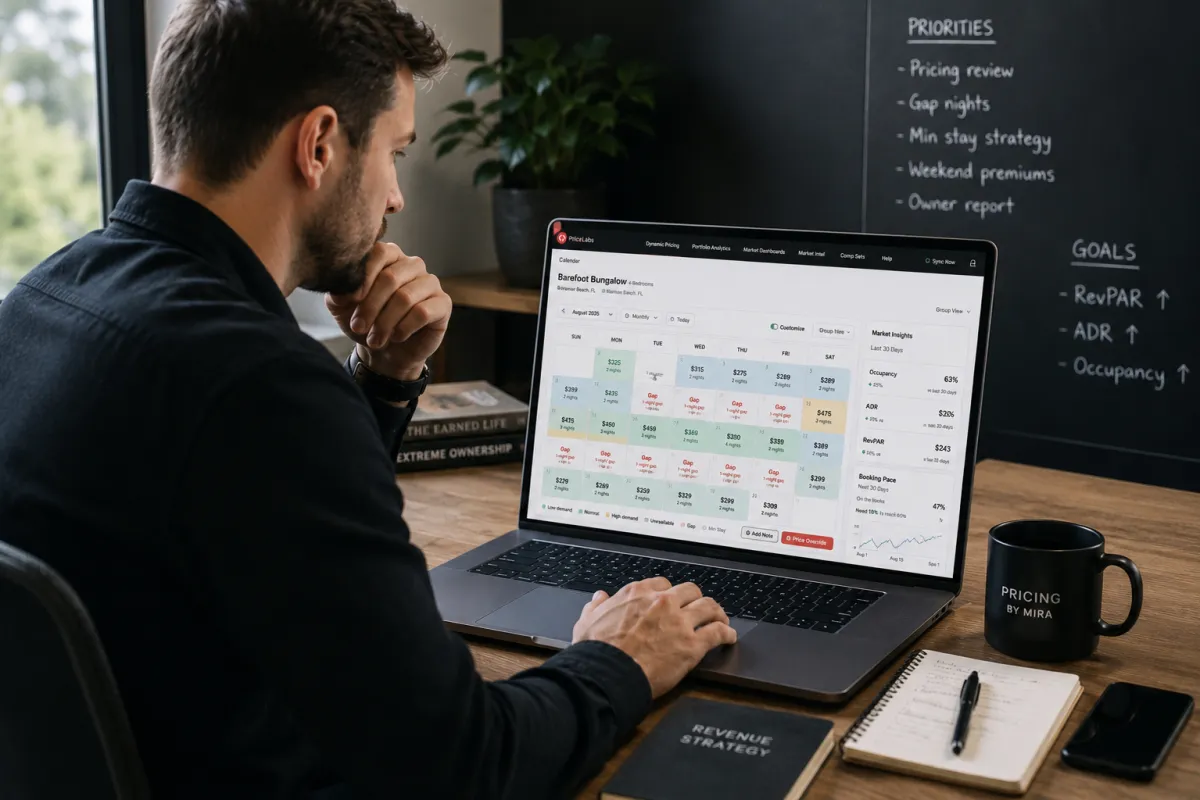
Large calendar gaps remain unfilled
Revenue recovery becomes a priority
The purpose is to create movement.
Not to permanently lower rates.
Why Empty Nights Are Expensive
One of the most important concepts discussed during the session was opportunity cost.
An unbooked night produces:
No revenue
No occupancy
No contribution toward monthly goals
At some point, an empty night becomes more expensive than a discounted booking.
This is often where operators struggle.
They focus on protecting ADR while overlooking the revenue consequences of vacancy.
Revenue managers think differently.
They ask:
What creates the highest and best revenue outcome from this point forward?
Sometimes the answer is holding rates.
Sometimes the answer is creating urgency through pricing.
Shock Pricing Is Not Panic Pricing
One of the biggest misconceptions about shock pricing is that it means desperation.
It doesn't.
Panic pricing is emotional.
Shock pricing is strategic.
Panic pricing typically looks like:
Random discounts
Frequent rate changes
Emotional reactions to vacancies
Undercutting competitors without analysis
Shock pricing follows a framework.
It is based on:
Occupancy pacing
Booking windows
Market demand
Revenue targets
Remaining inventory
The objective is controlled intervention rather than emotional reaction.
Timing Matters
Shock pricing is most effective when timing supports it.
For example:
If a market typically books 90 days in advance, applying shock pricing 120 days before arrival may be unnecessary.
Demand has not had time to materialize.
However, if arrival is only 14 days away and occupancy remains well below target, stronger action may be justified.
This is why revenue managers pay close attention to:
Booking windows
Pickup reports
Occupancy pacing
Remaining lead time
Timing determines whether a price reduction is strategic or premature.
Occupancy Goals Drive the Decision
Throughout the Week 5B session, Emile repeatedly emphasized occupancy and revenue outcomes over ADR alone.
Shock pricing often becomes relevant when:
Occupancy is lagging
Monthly revenue goals are at risk
Remaining inventory becomes increasingly difficult to sell
At that stage, the objective shifts.
Instead of asking:
Can we achieve a higher rate?
Revenue managers begin asking:
What gives us the highest probability of converting available nights?
Occupancy becomes part of the solution.
Shock Pricing Can Create Momentum
One interesting concept discussed during the training is the idea of booking momentum.
A booking does more than generate revenue.
It can:
Improve occupancy pacing
Reduce inventory pressure
Create confidence in pricing strategy
Improve calendar positioning
In some cases, a strategically discounted booking can create positive momentum that helps future dates perform more effectively.
This is especially important when operators have large blocks of unsold inventory.
Other Levers Should Be Considered First
One of the most valuable lessons from the session is that revenue management is not always about reducing price.
Before using shock pricing, operators should evaluate other tools such as:
Minimum stay adjustments
Length-of-stay discounts
Adjacency rules
Availability restrictions
Date-specific overrides
Far-out pricing settings
Sometimes occupancy problems can be solved without significant price reductions.
The best revenue managers understand how to use multiple levers together.
When Shock Pricing Makes Sense
Shock pricing may be appropriate when:
Booking Windows Are Closing
Demand has not materialized and time is running out.
Occupancy Is Well Behind Target
Monthly revenue goals are increasingly difficult to achieve.
Market Pickup Remains Weak
Recent booking activity suggests limited demand.
Large Gaps Remain Open
Unbooked inventory creates significant revenue risk.
In these situations, strategic intervention may outperform passive waiting.
When Shock Pricing Does Not Make Sense
Shock pricing is not appropriate simply because a date remains unbooked.
Revenue managers should avoid aggressive discounting when:
Demand remains healthy
Booking windows are still open
Pickup activity is strong
Occupancy pacing is on track
Market conditions support patience
Discounting too early can reduce revenue unnecessarily.
Not every vacancy requires immediate action.
Revenue Managers Measure the Results
The decision does not end once rates are adjusted.
After implementing shock pricing, operators should review:
Booking response
Occupancy changes
Revenue impact
Remaining inventory
Market behavior
This feedback helps determine whether the adjustment achieved its intended outcome.
Revenue management is iterative.
Every intervention should be measured.
The Real Goal Is Revenue, Not Occupancy Alone
It is important to remember that shock pricing is not designed to maximize occupancy at any cost.
The goal is still revenue optimization.
The best operators understand that:
Occupancy matters
ADR matters
RevPAR matters
Revenue matters most
Shock pricing is simply one tool within a larger revenue management strategy.
Used correctly, it can help recover performance without undermining long-term positioning.
Final Thoughts
Shock pricing is often misunderstood.
When applied strategically, it can help operators:
Recover occupancy
Improve pacing
Generate booking momentum
Protect monthly revenue goals
But it should never be the first response to an open calendar.
The strongest revenue managers evaluate:
Booking windows
Market demand
Occupancy targets
Revenue goals
Alternative levers
before making pricing decisions.
Because successful revenue management is not about discounting more.
It is about knowing when discounting creates the greatest value.
Key Takeaways
Shock pricing is a strategic occupancy recovery tool
Empty nights often create greater revenue risk than discounts
Shock pricing differs from panic pricing
Timing and booking windows matter
Occupancy goals influence pricing decisions
Other levers should be evaluated before reducing rates
Revenue managers measure outcomes after every adjustment


