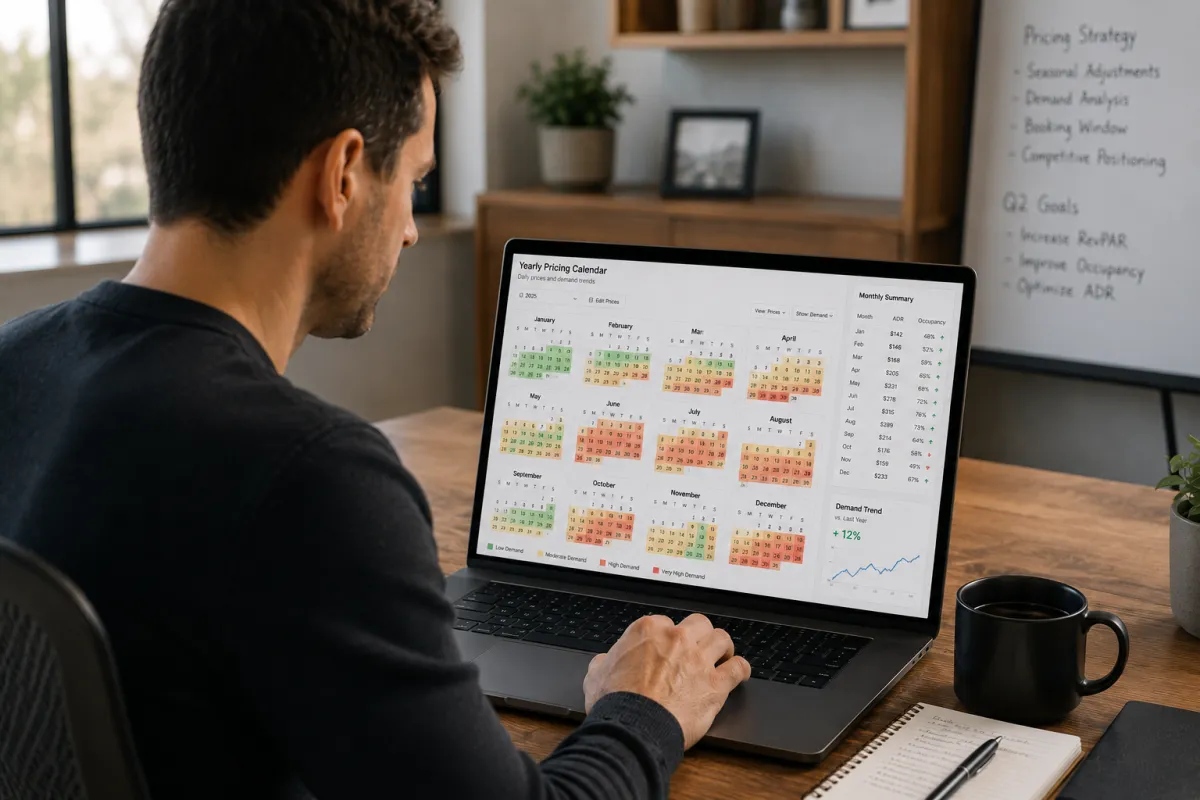
How to Build Seasonal Pricing Profiles for Short-Term Rentals
How to Build Seasonal Pricing Profiles for Short-Term Rentals
Seasonality is one of the biggest drivers of revenue in short-term rentals.
Yet many operators still rely on broad pricing seasons such as:
Summer
Fall
Winter
Spring
Although these categories are easy to manage, they rarely reflect how guests actually book.
Demand can change dramatically within the same season.
December behaves differently from January.
Early August often performs differently from late August.
Holiday weeks can completely reshape booking patterns.
During a Revenue Academy training session, Neil Sael explained that revenue managers should stop thinking in quarters and begin thinking in monthly seasonal profiles that reflect real market behavior.
The goal isn't to create more complicated pricing.
It's to create more accurate pricing.

Why Broad Seasons Often Miss Revenue Opportunities
Many operators create a single pricing profile for an entire season.
For example:
Summer: Memorial Day through Labor Day
Winter: December through February
The problem is that demand rarely follows those boundaries.
Even within the same season you may experience:
Different occupancy levels
Different booking windows
Different guest types
Different average lengths of stay
Different pricing opportunities
Treating every summer month the same can lead to underpricing peak demand or overpricing slower periods.
Monthly pricing profiles allow operators to respond to these differences with greater precision.
Build Seasonal Profiles Around Monthly Demand
Rather than relying on four seasons, the Revenue Academy recommends creating monthly pricing profiles based on historical market trends.
Each month should be evaluated independently by reviewing factors such as:
Occupancy trends
Average daily rate (ADR)
RevPAR
Booking windows
Average length of stay
Revenue performance
For example:
January may require aggressive pricing to improve occupancy.
March could benefit from spring break demand.
July may support premium pricing with fewer restrictions.
September might need different strategies as travel slows after summer.
Looking at each month separately creates a pricing strategy that better reflects actual guest demand.
Study Trends Instead of Chasing Market Averages
One of the strongest messages from the session was to focus on trends rather than copying average market performance.
Historical occupancy percentages help reveal whether demand is increasing or decreasing throughout the year.
They should not become pricing targets.
Instead, operators should ask questions like:
When does demand begin to slow?
Which months consistently outperform others?
When do booking windows become shorter?
Which periods require stronger occupancy strategies?
Understanding these trends allows you to prepare pricing well before demand changes.
Separate Holidays from Seasonal Profiles
Not every high-demand period belongs inside a seasonal profile.
Major holidays often behave differently from the rest of the month.
Examples include:
Thanksgiving
Christmas
New Year's
Memorial Day
Labor Day
Rather than increasing prices for an entire month, consider keeping your monthly profile consistent while using date-specific overrides for holidays.
This creates a cleaner pricing structure and allows you to respond more accurately to holiday demand without affecting surrounding dates.
Base Price Adjustments Can Improve Slow Seasons
Seasonal profiles aren't only about increasing prices during busy periods.
They can also help improve occupancy during slower months.
If historical data shows that January and February consistently experience weak demand, operators may choose to lower seasonal base prices in advance rather than waiting to discount rates at the last minute.
Planning ahead offers several benefits:
Better visibility in search results
Earlier bookings
More predictable occupancy
Less reliance on last-minute discounts
Instead of reacting when calendars remain empty, operators can build a proactive pricing strategy before the season begins.
Every Property Has Its Own Seasonal Identity
Seasonality isn't identical across every market.
A beachfront destination may peak during summer.
A ski destination may generate most of its revenue during winter.
A property with unique amenities—such as an indoor heated pool—may outperform surrounding listings during traditionally slow periods.
Because of this, seasonal pricing should always reflect the individual property's strengths rather than relying entirely on neighborhood averages.
Revenue managers should combine market data with property-specific performance to build pricing profiles that fit their own listings.
Review Seasonal Profiles Every Year
Seasonal pricing isn't something you configure once and forget.
Markets evolve.
School calendars change.
Booking behavior shifts.
New events create demand.
Old demand patterns disappear.
Reviewing seasonal profiles annually helps operators:
Adjust revenue targets
Update pricing strategies
Improve occupancy
Refine booking windows
Respond to changing market conditions
Historical data provides valuable guidance, but every new year deserves a fresh review.
Build the Foundation Before Advanced Revenue Management
Throughout the session, Neil emphasized that seasonal profiles form the foundation of every pricing strategy.
Advanced revenue management tactics become much more effective when the underlying seasonal settings are already aligned with market behavior.
Without a strong seasonal foundation, operators often spend unnecessary time making manual overrides and reactive pricing adjustments.
Building accurate monthly profiles reduces those corrections and creates a more consistent pricing system throughout the year.
Final Thoughts
Successful revenue management starts with understanding seasonality.
Rather than treating every summer or winter month the same, operators should build monthly pricing profiles that reflect real booking patterns, guest behavior, and historical performance.
Combining monthly seasonality with holiday overrides, thoughtful base price adjustments, and regular annual reviews creates a pricing strategy that is proactive, flexible, and easier to manage.
The more accurately your pricing reflects the way demand changes throughout the year, the better positioned you'll be to maximize revenue while maintaining healthy occupancy.
Key Takeaways
Monthly seasonal profiles provide more accurate pricing than broad quarterly seasons.
Historical trends are more valuable than simply copying market averages.
Separate holidays from regular seasonal pricing whenever possible.
Slow seasons often require proactive base price adjustments.
Every property should have seasonal settings based on its own performance.
Review seasonal profiles every year as market conditions evolve.


