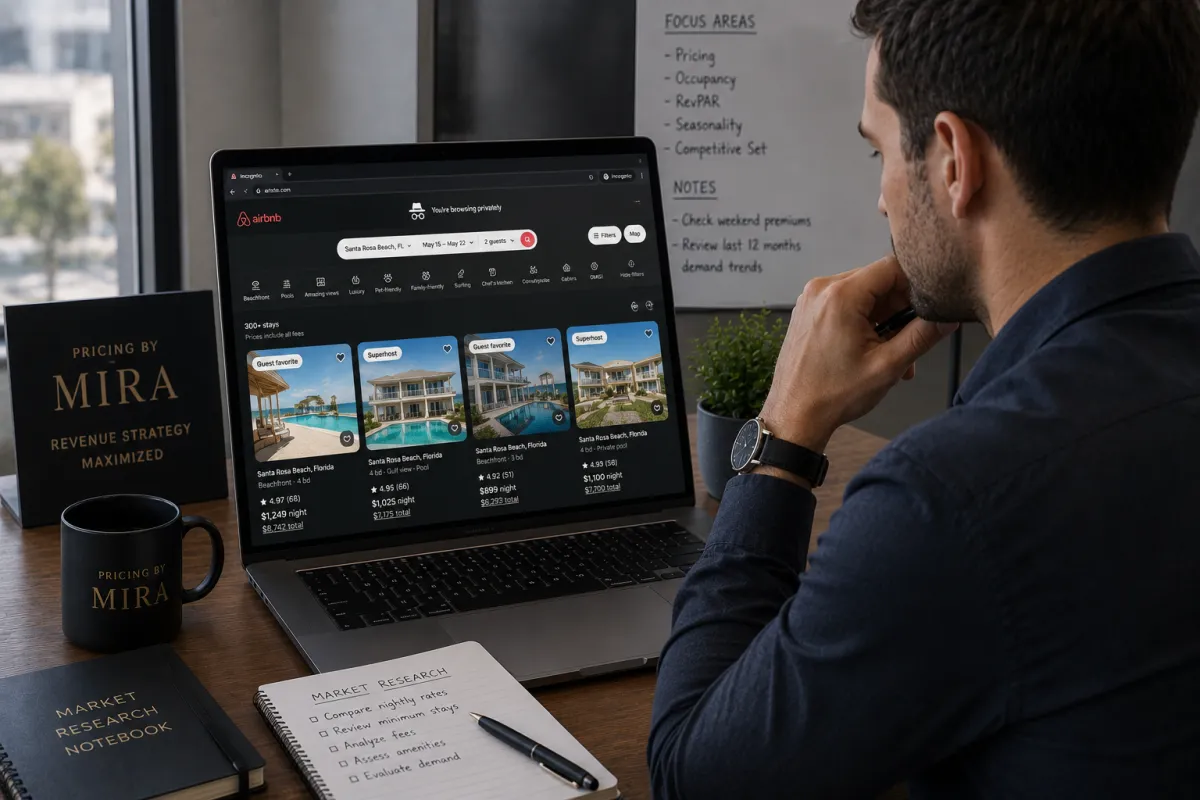
How to Build Airbnb Comp Sets Manually Using Incognito Search
How to Build Airbnb Comp Sets Manually Using Incognito Search
Revenue management tools have become incredibly powerful.
Platforms like PriceLabs, AirDNA, and STR Insights allow operators to analyze:
Occupancy trends
ADR
RevPAR
Booking windows
Market supply
Seasonal performance
But even with all of those systems available, there is still one technique many experienced revenue managers continue to use regularly:
Manual Airbnb searches.
In a Revenue Academy training session, Emile Sakhel and Adam Blake explained why manually researching Airbnb listings through incognito searches remains an important part of STR revenue management and comp set building.
Sometimes the best market insights come from seeing the platform exactly the way guests see it.

Why Manual Comp Research Still Matters
Automated dashboards are useful.
But no dashboard fully replaces human observation.
Revenue management tools rely heavily on:
Filters
Categorization
Scraped listing data
Platform integrations
Automated assumptions
That creates limitations.
Some properties:
May be tagged incorrectly
May not appear inside dashboard filters
May position themselves differently visually
May outperform because of branding or presentation
May dominate Airbnb search visibility despite average pricing
Manual research helps operators identify these gaps.
As Emile explained during the session, there is never just one way to approach revenue management.
The best operators combine:
Automated data analysis
Manual market review
Guest-perspective research
Real-world search behavior
That combination creates a more complete understanding of competition.
Why Incognito Searches Are Important
One of the biggest recommendations from the session was using Airbnb in incognito mode.
This matters because Airbnb personalizes search results.
If operators stay logged into their own account:
Their own listings may appear higher
Previous search history may influence results
Saved listings may affect recommendations
Cookies may distort visibility
That creates a misleading view of the market.
Using incognito mode provides a cleaner look at:
Real guest search results
Organic listing visibility
Competitive placement
Search ranking behavior
As Adam explained during the session, revenue managers often close and reopen incognito windows repeatedly to avoid cached browsing influence.
The goal is to simulate the experience of a completely new guest searching the market for the first time.
How Revenue Managers Use Manual Airbnb Searches
Manual Airbnb searches serve several strategic purposes.
1. Building Better Comp Sets
Revenue managers often search Airbnb manually to identify:
Listings with similar design
Comparable guest experiences
Similar locations
Matching amenities
Equivalent property positioning
Sometimes a property feels highly competitive from a guest perspective even if dashboard filters do not surface it automatically.
This helps operators build more realistic comp sets.
2. Understanding Search Visibility
Search visibility matters heavily in STR performance.
Manual searches help operators understand:
How far down their listing appears
Which competitors dominate visibility
How crowded certain date ranges become
Which listings stand out visually
What amenities competitors emphasize
This perspective is difficult to fully understand through dashboards alone.
3. Evaluating Slow-Season Competition
During weak demand periods, search visibility becomes even more important.
As discussed in the session, operators may use incognito searches during slow dates to evaluate:
Inventory saturation
Competitor pricing pressure
Visibility changes
Market positioning
This helps determine whether pricing adjustments may be necessary.
Sometimes operators discover:
Their listing is buried deep in search results
Competitors are heavily discounting
Certain property types dominate visibility
These observations can influence revenue strategy decisions.
Airbnb Search Behavior Reveals Guest Priorities
One of the biggest advantages of manual Airbnb research is learning how guests experience the marketplace.
Guests do not analyze dashboards.
They browse:
Photos
Titles
Amenities
Pricing
Location positioning
Search rankings
That means comp analysis should include more than just numbers.
Revenue managers should ask:
Which listings stand out visually?
Which titles attract attention?
Which amenities appear repeatedly?
What types of homes dominate page one?
What booking experience feels strongest?
This creates a much more realistic understanding of competition.
Manual Research Helps Identify Missed Opportunities
During the session, Adam also explained how operators sometimes discover overlooked market trends manually.
For example:
Certain amenities may become common in listing headlines
“Pool” or “Mountain View” may appear repeatedly
Specific design styles may dominate search visibility
Certain guest segments may become more targeted
These trends may not yet appear clearly inside automated dashboard filters.
Manual observation helps operators identify:
Emerging competitive patterns
Listing presentation trends
Search behavior shifts
Guest demand signals
before competitors fully react.
Manual Comp Sets Can Work Alongside Dashboards
The session also demonstrated how manual Airbnb research can integrate with tools like PriceLabs.
Operators can:
Discover listings manually through Airbnb
Copy Airbnb listing IDs
Import those listings into comp set dashboards
Combine manual research with data analysis
This creates a hybrid approach that combines:
Human observation
Dashboard analytics
Revenue metrics
Guest-perspective analysis
Rather than choosing between automation and manual review, advanced operators use both together.
Revenue Management Requires Perspective
One of the strongest themes throughout the training was perspective.
Dashboards show data.
But Airbnb searches show behavior.
The best revenue managers understand both.
That means regularly viewing the market:
Like a guest
Like a competitor
Like a strategist
Like a revenue manager
The operators who consistently outperform competitors are often the ones paying closer attention to how guests actually interact with the marketplace.
Final Thoughts
Manual Airbnb comp research may seem simple, but it remains one of the most valuable habits in STR revenue management.
Incognito searches help operators:
Build stronger comp sets
Understand search visibility
Study competitor positioning
Identify market trends
Improve pricing strategy
Analyze guest behavior more realistically
Dashboards provide critical data.
But sometimes the most valuable insights still come from opening Airbnb and searching like a guest.
Key Takeaways
Manual Airbnb searches remain valuable for revenue management
Incognito mode creates a more accurate guest perspective
Search visibility strongly impacts STR performance
Manual research helps improve comp set quality
Guest behavior matters as much as pricing data
Dashboards and manual research work best together
Revenue management requires both analytics and observation


